

Lichen Sclerosus Treatment
Dr Nadia Yousri offers treatment options for Lichen sclerosus for both male and female patients at her Harley Street Clinic in London. Many patients suffer from this life-altering skin condition, some in silence, unknowing that they have treatment options open to them.
- Top Intimate Health Doctor
- Harley Street, London Clinic
- Individualised Care
- Excellent Results
Table of Contents
What is Lichen Sclerosus?
Lichen Sclerosus lesions often start as chronic skin inflammation, appearing as itchy white patches (leukoplakia). The affected skin becomes thin, resembling tissue paper, and can easily crack and bleed from light itching or even a gentle touch.
The inflammation and raw surfaces instigate fusion and scarring of adjacent parts. Wrinkling, tightening, and distortion of the whole affected area can follow.
Lichen Sclerosus affects the anogenital area as well as other parts of the body.
The treatment plan would include steps to prevent future attacks from developing, to be confident of your health and wellness at any stage of your life. When it comes to problems, early detection is often critical to successful treatment. For those ladies with family history of hereditary Gynaecological condition (Breast Ca genes BRCA1, BRCA2), they would require more wider assessment, specific screening tests and possibly counseling, and a timed surveillance plan.
How common is Lichen Sclerosus?
It is thought that many patients, for one reason or another, suffer underdiagnosed and undertreated Lichen Sclerosus, with many patients suffering in silence throughout their lives.
The prevalence of Lichen Sclerosus is estimated between 1 in 300-800 individuals. About 10% of patients have other family members with the same condition.
The autoimmune disease is more common in women than men and occurs more often in adults than children.
Lichen sclerosus is mainly found in the anogenital area (intimate area) area but can also be found to be more generalised in its location. Extragenital involvement is reportedly present in 6% to 20% of patients.
What is Genital Lichen Sclerosus?
The lesions of lichen sclerosus are found on the affected skin in the genital and anal areas of men and women. It affects five to ten times as many women (most frequently postmenopausal women) as men.
In men, LS affects the head of the penis (the glans) and the foreskin and anal region.
In women, LS lesions are found in the vulval structures (vaginal introitus, labia minora, clitoris, urethral opening, and lower part of vaginal canal) and also the anal area.
What Causes Lichen Sclerosus?
Even though the exact cause is unknown, Lichen Sclerosus is thought to have an autoimmune origin, where the body’s immune system attacks healthy skin tissue. It is not contagious or sexually transmitted. Factors that may contribute to its development include:
- Genetic predisposition (family history of autoimmune disease)
- Hormonal changes, particularly low oestrogen levels after menopause
- Skin trauma (Koebner phenomenon)
- Infections or chronic irritation
- Past radiation therapy to the pelvic region
Understanding and managing these potential triggers is key to reducing flare-ups.
What Are the Features of Lichen Sclerosus?
Common symptoms include itching, irritation and discomfort caused by fragile, thinning skin.
Inflammation may lead to redness, white skin changes, dryness, scarring and fissures (cracks in the skin).
Scratching or rubbing the affected area can worsen symptoms and lead to further skin damage.
In more advanced cases, scarring may cause tightening of the tissues, which can lead to discomfort during activities such as sexual intercourse, cycling or wearing tight clothing.
Although these features may suggest lichen sclerosus, diagnosis may require confirmation through clinical examination and occasionally a skin biopsy.
Even after successful treatment, symptoms may recur.
Diagnosing Lichen Sclerosus
Diagnosing Lichen Sclerosus requires a careful clinical evaluation, as it can mimic other skin conditions such as leukoplakia, chronic eczema, psoriasis, vitiligo, recurrent candidiasis & lichen planus. A visual examination is often followed by a skin biopsy, particularly in cases that are atypical or treatment-resistant, to confirm the diagnosis and rule out precancerous changes.
Early and accurate diagnosis is essential to begin appropriate treatment and reduce the risk of long-term complications, including the slightly elevated risk of progression to vulval or penile cancer. Patients are encouraged to seek specialist care promptly if symptoms such as chronic itching, skin fragility (fissuring) or non-healing ulcers persist.
Men and women can both suffer from Lichen Sclerosus
| Condition | Details |
|---|---|
| Lichen Sclerosus in Women |
|
| Lichen Sclerosus in Men |
|
Why Early Treatment and Follow-Up Are Important
Lichen sclerosus is a chronic condition that tends to occur in cycles of flare-ups and remission.
Without appropriate treatment, persistent inflammation may lead to scarring and structural changes in the affected tissues.
Regular follow-up helps monitor disease activity, adjust treatment when needed and detect early signs of complications.
How treatment is planned over time for Lichen Sclerosus?
Lichen Sclerosus is a chronic inflammatory condition, and effective management focuses on long-term control rather than short-term symptom suppression alone. Treatment plans are therefore developed in stages, based on disease activity, response to therapy, and individual risk factors.
In the early or active phases, treatment is aimed at reducing inflammation, relieving symptoms, and preventing scarring or anatomical distortion. Once symptoms are controlled and the condition is stable, ongoing maintenance and regular follow-up become central to care. This helps minimise flare-ups, monitor tissue changes, and reduce the risk of long-term complications.
For some patients, treatment needs evolve over time and may include different modalities at different stages of the condition. Regular review allows therapy to be adjusted appropriately, ensuring management remains proportionate, effective, and safe.
This structured, long-term approach is essential in protecting both tissue health and quality of life for patients living with Lichen Sclerosus.
How is Lichen Sclerosus Treated?
It is agreed that lichen sclerosus can pose a treatment challenge to physicians and surgeons.
Treatment options for LS range from pharmacological to surgical, depending on the severity and location of the disease, patient and risk factors alone, and response to previous treatments.
Patients with lichen sclerosus usually require long-term follow-up because the condition is associated with a small increased risk of squamous cell carcinoma affecting the vulva, penis or anus.
Patients should seek medical review if they notice:
• a new lump
• thickening of the skin
• persistent ulcers
• changes in skin appearance
Topical Medications For Lichen Sclerosus.
First-line treatment typically involves ultra-potent topical corticosteroids such as clobetasol 0.05 percent ointment.
These medications reduce inflammation and relieve symptoms.
Treatment schedules are individualised and should always be followed according to medical advice.
Topical corticosteroids control inflammation but do not cure the underlying autoimmune process, therefore ongoing monitoring is important.
Oral medication
Oral medications are used less commonly and are usually considered when topical treatments fail to control symptoms.
These treatments are prescribed on an individual basis following specialist assessment.
Surgical options
Surgical options are considered when cicatrisation and fibrosis occur, impairing the function and distorting the anatomy of the area.
Potential Surgical Indications in Women
- If the vulva (external genitalia) shrinks, along with the clitoris and small inner lips (labia minora) around the opening of the vagina are affected.
- If Lichen Sclerosus is severe, you might need a small operation, such as surgery to remove the fusion of the scarred tissues to free the clitoris out of the vagina and to widen the toughened vaginal opening.
Potential Surgical Indications in Men
- For men, to relieve the pain during erection, sometimes circumcision is suggested to remove the affected foreskin (though it would not help if the head of the penis -the glans- is affected, nor will surgery intervention prevent its progression)
- In both genders, when LS causes urethral stricture, urethral dilatation is unlikely to be successful long-term treatment in-term, and surgery is often required, such as meatoplasty, single- or two-stage urethroplasty, or perineal urethrostomy.
Non-Surgical Options for Lichen Sclerosus
Lichen sclerosus is a chronic condition that may relapse over time.
No current treatment, including regenerative procedures, is considered a definitive cure.
Maintenance therapy and regular clinical follow-up remain important.
Individual outcomes vary and improvement cannot be guaranteed.
All treatment decisions are made following full medical assessment and informed consent.
Regenerative Injection Therapies (PRP)
Platelet-rich plasma (PRP) injections — commonly known as O-Shot® (for women) and P-Shot® (for men) — aim to utilise growth factors derived from the patient’s own blood to support tissue health.
Evidence for PRP in lichen sclerosus remains limited and evolving. Current data consist mainly of small case series and pilot studies. There is no established evidence that PRP cures lichen sclerosus or the underlying autoimmune process.
Where offered, PRP is considered an endeavour that could help in alleviating the troubling symptoms with possible improvement in the tissue’s integrity.
Important Note:
PRP-based procedures such as O-Shot® and P-Shot® are generally considered only after standard treatments, including topical corticosteroids, have been used or discussed.
In some cases, the clinic may recommend adjusting or limiting steroid use around the time of regenerative procedures. This approach is based on research suggesting corticosteroids may influence wound healing and growth factor activity. Decisions regarding steroid use are always made individually following clinical assessment.
Laser-Based Therapies
Laser therapy has been explored in some small clinical studies as a potential treatment for genital lichen sclerosus in both women and men. These studies have investigated fractional CO₂ laser treatment.
Current evidence remains limited, and studies have not demonstrated consistent reduction of inflammation. For this reason laser therapy is not considered a standard treatment.
This treatment option is not currently offered at Dr NY Clinic.
Important Considerations
Lichen sclerosus is a chronic condition with a tendency to relapse.
No current treatment is considered a definitive cure.
Maintenance therapy and regular follow-up remain essential.
Individual outcomes vary, and improvement cannot be guaranteed.
All treatment decisions are made following a full medical assessment, discussion of alternatives, and informed consent.
Ongoing Care and Monitoring
Long-term follow-up is important to monitor symptom control, assess response to treatment, identify early signs of disease recurrence or flare-ups, and detect any suspicious tissue changes that may require further investigation. Patients may also be advised to remain enrolled in relevant NHS screening programmes.
Practical advice for patients includes:
- Avoiding irritants such as perfumed soaps
- Wearing non-restrictive clothing
- Seeking prompt medical review if new lesions, persistent ulceration, or changes in appearance occur
Biopsy is recommended only when clinically indicated, particularly in areas that appear atypical, persistent, or suspicious. Review intervals are individualised according to disease severity and each patient’s risk profile.
Authoritative Sources
British Society for the Study of Vulval Disease (BSSVD)
Management Guidance. https://bssvd.org
2. Effects of Steroids and Retinoids on Wound Healing (mechanistic: growth factors in wounds). Wicke C, et al. JAMA Surgery Vol. 135, No. 11 (2000).
3. Glucocorticoid inhibits thrombin-induced expression of platelet-derived growth factor A-chain and heparin-binding epidermal growth factor-like growth factor in human aortic smooth muscle cells, T Nakano etal, J Biol Chem. 1993 Oct 25;268(30):22941-7.
4. Corticosteroids and Local Anaesthetics Decrease Positive Effects of PRP on Tenocytes (in vitro). Carofino B, et al. Journal of Shoulder and Elbow Surgery Volume 28, Issue 5, May 2012, Pages 711-719.
5. JCPM2025.02.25 O-Shot® for Lichen Sclerosus
https://oshot.info/members/jcpm2025-02-25-o-shot-for-lichen-sclerosus-to-prevent-cancer-make-a-web-page-in-5-minutes/
6. Regenerative therapies in lichen sclerosus genitalis patients and possible efficacy in preventing squamous cell carcinoma development: a long-term follow-up pilot study. Marinella Tedesco et al, Dermatol Reports, . 2024 Nov 27;17(2):10079. Published on https://pmc.ncbi.nlm.nih.gov/articles/PMC12282575/
7. Intradermal injection of autologous platelet-rich plasma for the treatment of vulvar lichen sclerosus. Andrew T Goldstein, Michelle King 2, Charles Runels. J Am Acad Dermatol, 2017 Jan;76(1):158-160. Published on https://pubmed.ncbi.nlm.nih.gov/27986140/
8. Is there a role for platelet rich plasma injection in vulvar lichen sclerosus? A self-controlled pilot study. Boero V, Brambilla M, Monti E, Arch Gynecol Obstet. 2024 Jun;309(6):2719-2726. doi: 10.1007/s00404-024-07424-2. Epub 2024 Mar 24. PMID: 38523203
9. Regenerative Approaches in Vulvar Lichen Sclerosus: A Systematic Review.
Beutler K, Jankowska-Konsur A, Nowicka D. Int J Mol Sci. 2025 Sep 10;26(18):8808. doi: 10.3390/ijms26188808.PMID: 41009377
10. Platelet-Rich Plasma: A Comprehensive Review of Emerging Applications in Medical and Aesthetic Dermatology. Christopher White, Allyson Brahs, David Dorton. J Clin Aesthet Dermatol, 2021 Nov;14(11):44-57. Published on https://pubmed.ncbi.nlm.nih.gov/34980960/
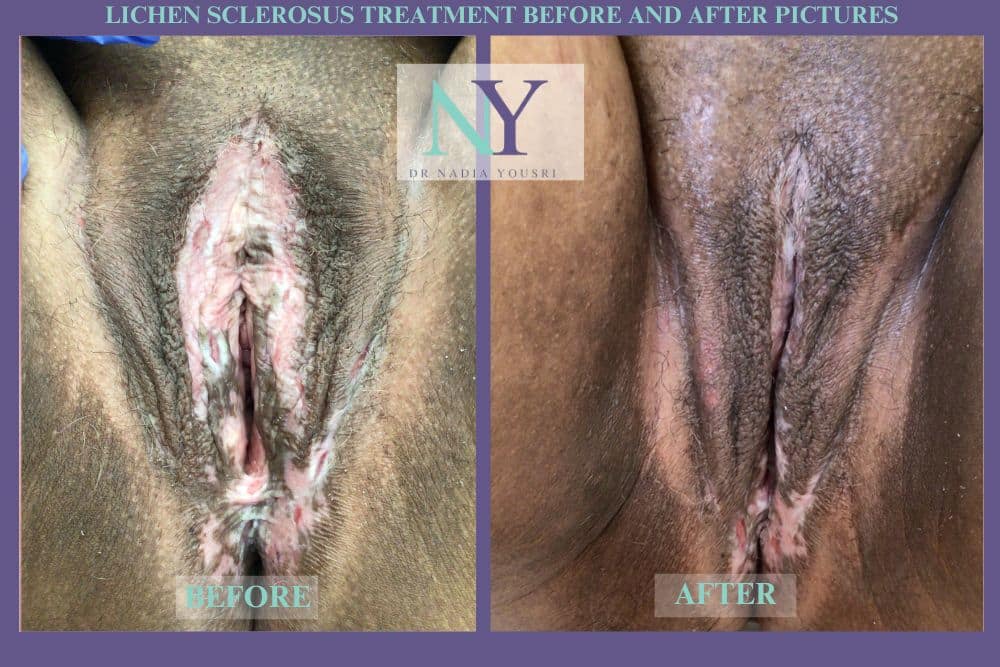
Lichen Sclerosus Treatment Before and After pictures
Please click on the button below to view before and after pictures of Lichen Sclerosus treatment

The next steps for Lichen sclerosus sufferers
Get in touch through the form below to arrange a consultation or to ask a question about this treatment. We are here to help!
Frequently Asked Questions (FAQs)
Is Lichen Sclerosus contagious?
No. Lichen sclerosis is not a sexually transmitted or contagious condition.
Can I have sex if I have Lichen Sclerosus?
Yes, but it may be uncomfortable during flare-ups. Some patients report symptom improvement with certain treatments, although evidence remains limited and outcomes vary.
Does Lichen Sclerosus increase cancer risk?
Yes. There is a slightly increased risk of vulval or penile squamous cell carcinoma, especially in long-standing cases. This is why long-term monitoring is essential.
Will the symptoms come back after treatment?
While some treatments can achieve remission, LS can reoccur. Maintenance treatment, early detection of flare-ups, and follow-up care are key to managing the condition effectively.
What’s the difference between Lichen Sclerosus and Lichen Planus?
Both are inflammatory skin conditions, but they differ in appearance, symptoms, and management. A skin biopsy can help distinguish between the two.
Disclaimer: This page is for informational purposes only and does not constitute medical advice. Please consult a qualified healthcare professional for personalised diagnosis and treatment.






meet Dr Nadia Yousri
Sexual Wellness & Regenerative Medicine
Doctor Nadia Yousri is Triple Qualified OB&GY Surgeon (FRCOG, MRCOG, PhD in OB&GY, Master Degree in OB&GY, DFSRH) is a highly qualified & experienced Obstetrician, Gynaecologist, Fertility, Sexual Wellness, Aesthetic Gynaecology & Regenerative Medicine Specialist Consultant. She is a Fellow of the Royal College of OB&GY- London since 2009. Her higher qualifications include PhD in OB&GY & Master degree in OB&GY & DFFP & University Lecturer Degree.
Request A Consultation
Please complete the below form to book a face to face consultation with Dr Nadia Yousri.